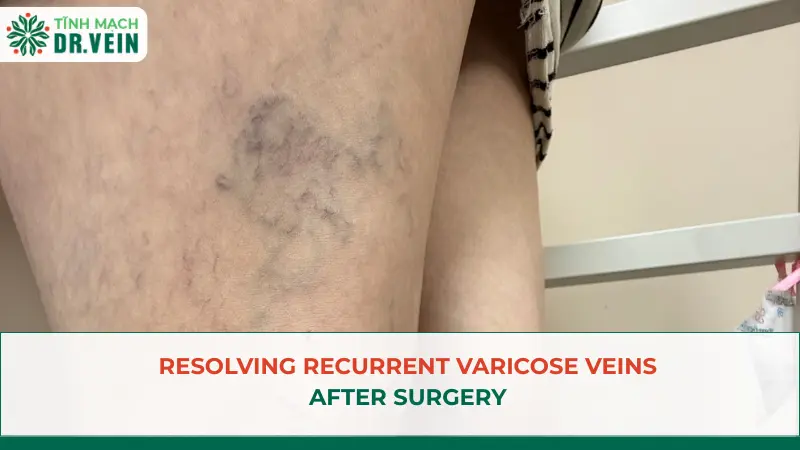
Today’s modern medicine possesses many optimal intervention methods, capable of completely eliminating severely deteriorated blood vessel branches. However, there is no medical technique that can create a permanent protective shield for the remaining healthy veins. If patients are subjective and lack strict adherence to at-home conservative measures, the risk of recurrent varicose veins is always present and ready to attack new locations on the legs.
The follow-up visit story of Ms. T.T.T.G. (57 years old) is an extremely profound clinical lesson. Despite being extremely successfully treated by the Dr. Vein team in the past, it was her very negligence and over-reliance on medical results that caused her legs to cry out for help once again.
Reviewing the Old Medical Record: Severe Pathology Once Completely Resolved
Over a year ago, Ms. G. came to Dr. Vein with both legs covered in a dense network of bulging green veins, accompanied by severe pain. Based on the medical record, her condition at that time was highly complex, requiring a combined multi-modal regimen.
Specifically, Dr. Le Kim Cao (MSc, Specialist Level II) outlined an extremely detailed treatment regimen including:
- EVLA for the left leg: Endovenous Laser Ablation to eliminate the severely insufficient great saphenous vein in the left leg.
- UGFS for both legs: Ultrasound-Guided Foam Sclerotherapy to seal off the superficial refluxing vein branches hidden deep under the skin in both the right and left legs.
- Superficial Sclerotherapy: Surface treatment to eradicate unsightly spider and reticular vein clusters.
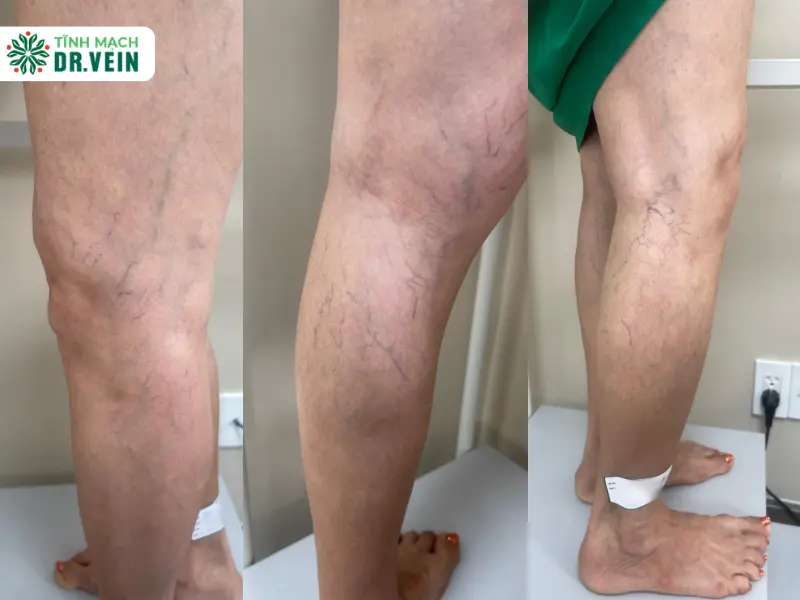
The comprehensive intervention that year was a resounding success. For a long time afterward, her legs felt completely light, without any sense of heaviness, and all daily activities took place very smoothly. The patient thought she had permanently bid farewell to this disease.
The Unexpected Nightmare Returns: Consequences of Subjectivity
After more than a year, in the past few months, Ms. G. began to feel the aching pain in her calves gradually returning. The intensity of the ache often increased in the late afternoon and evening, accompanied by a feeling of tightness under the skin. Tiny clusters of green veins began to slowly emerge again. These abnormal signs made her extremely anxious, losing sleep and appetite out of fear that she was facing the risk of recurrent varicose veins right at the location previously intervened by the doctor.
To relieve the patient’s anxiety and provide the most accurate medical conclusion, Dr. Le Kim Cao conducted a thorough review of the entire vascular system of both lower extremities using a Doppler ultrasound system. The imaging results yielded two extremely important pieces of information:
1. The previous intervention maintains its perfection
The ultrasound screen confirmed that the great saphenous vein trunk in the left leg was fully sclerosed and completely closed. There is no pathological reflux flow existing in this area. This result affirms that the past intervention technique was an absolute success, and the old root of the disease has been completely eradicated.
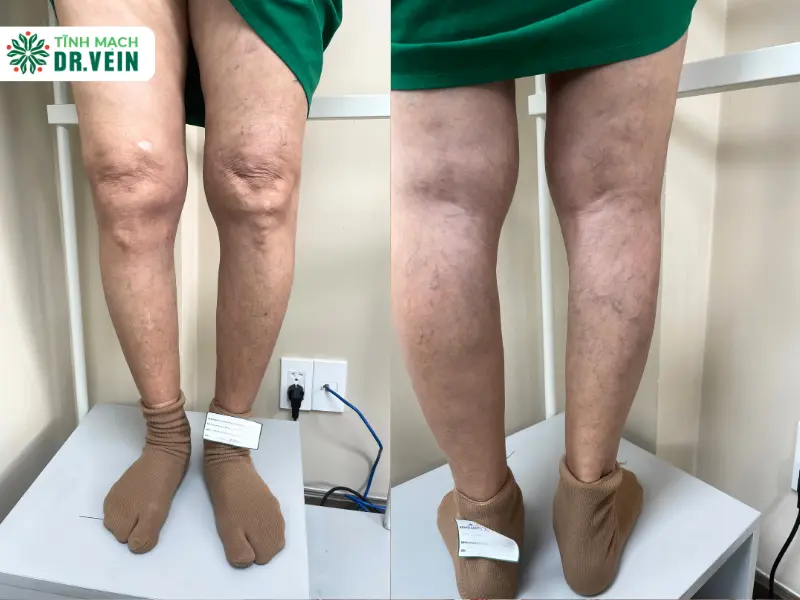
2. Detecting new pathological roots in the superficial branches
The real trouble lies not in the previously intervened main vein, but stems from other superficial vein branches in both legs. Under the ultrasound probe, these new vascular branches began showing signs of valvular insufficiency, abnormal dilation, and blood pooling.
Analyzing the Root Cause: The Fault Lies in Lifestyle Habits
Dr. Cao meticulously analyzed that the risk of recurrent varicose veins in these new branches stems from the very subjectivity and negligence during at-home care. The patient mistakenly believed that just a single intervention would make her legs permanently healthy.
Due to the specific nature of her trading profession, which requires continuous standing and sitting for many consecutive hours, Ms. G. completely forgot the habit of wearing protective medical compression stockings. The lower extremity circulatory system inherently has to operate at maximum capacity to push blood back to the heart. When the main vein branch is closed after the old surgery, the blood flow automatically redistributes to the surrounding collateral pathways. If the patient does not use compression stockings to assist in compressing the vessel walls, the entire body weight and blood flow pressure will directly compress the remaining healthy superficial veins.
Enduring immense pressure over a long period, the one-way valve system inside the branches loses its elasticity, leading to blood reflux. This is the core cause of the new chain of aching symptoms.
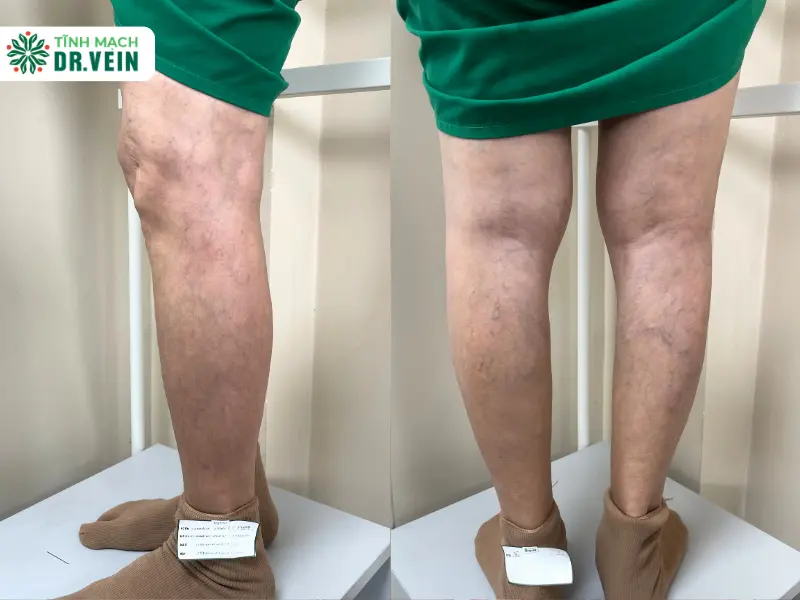
Medical Diagnosis: The patient has lower extremity venous insufficiency at the C1 level, on the background of a previously and stably treated great saphenous vein in the left leg.
A Gentle Treatment Regimen to Prevent Disease Spread
Clearly understanding the nature of the new lesion, Dr. Cao formulated a gentle, minimally invasive recovery regimen to definitively resolve the newly affected blood vessels, completely pushing back the risk of recurrent varicose veins spreading further:
Superficial Sclerotherapy: The doctor uses an ultra-fine needle to inject a medical solution directly into the lumen of the dilating superficial branches. This technique immediately stimulates an aseptic inflammatory response at the endothelium, causing the vessel walls to stick tightly together. The blood flow will automatically redirect to other healthy veins. The damaged vein branch will sclerose and gradually disappear over time, helping the legs escape the aching sensation.
Advice From the Doctor
This follow-up visit is a precious opportunity for the doctor to give a strict reminder about the importance of a disciplined lifestyle. To thoroughly eradicate the risk of recurrent varicose veins in the future, the patient must strictly adhere to the following principles:
- Maintain the habit of continuously wearing medical compression stockings: Compression stockings create a graduated pressure decreasing from the ankle up to the thigh, acting as an effective “auxiliary pump” to share the pressure burden on the entire lower extremity circulatory system.
- Proactively change working postures: Minimize bad postures that cause localized vascular compression, such as squatting or crossing the legs.
- Enhance daily physical activity: Perform appropriate walking, cycling, and swimming exercises. These activities help stimulate the calf muscles to contract strongly, promoting the circulatory blood flow back to the heart much more easily.
- Control body weight and maintain nutrition: Increase the intake of fiber and vitamin C from fresh vegetables and fruits to strengthen the durability of the blood vessel walls.
- Regular health monitoring: Adhere to the follow-up appointment schedule after 1 month for the doctor to use ultrasound to evaluate the response level of the latest sclerotherapy session.

Ms. T.G.’s case is a profound wake-up call for everyone: Resolving venous pathology is a lengthy journey, requiring an extremely close coordination between medical intervention techniques and at-home conservative efforts. Never rely solely on medicine. The persistence in changing lifestyle habits is the only golden key that helps you completely repel the risk of recurrent varicose veins, confidently possessing a pair of legs that are truly healthy, flexible, and highly aesthetic!
Contact Information
- Address: No. 2, My Toan 2 Residential Area, Tan Phong, District 7, Ho Chi Minh City
- Hotline: 0932.19.28.82
- Website: drvein.vn/en
- Business Hours: Monday – Saturday, 8:00 AM – 5:00 PM