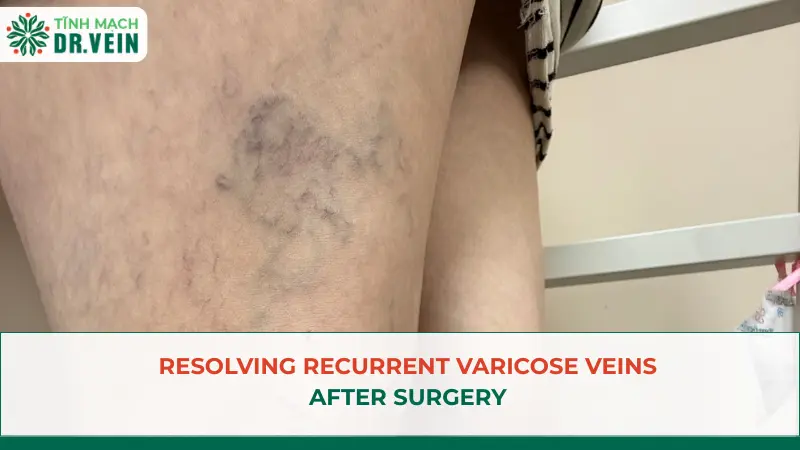
In most cases of leg varicose veins, the cause typically stems from the weakness of large superficial venous trunks. However, some people suffer from perforator vein insufficiency—a condition where damage occurs in the perforator veins, which are vessels responsible for draining blood from the superficial veins into the deep venous system. When the valves in these vessels are damaged, blood flows backward, causing large varicose clusters.
The case of Mr. P.N.C. (52 years old, from Tien Giang) is a typical example, where the cause of the disease did not lie in the main venous trunk but in the femoral perforator vein (Hunter perforator)—a rare form that is easily missed if not carefully diagnosed by Doppler ultrasound.
Initial Condition – Over 10 Years of Delayed Treatment
Mr. C. came to Dr. Vein with a large cluster of varicose veins in the left popliteal fossa (back of the knee), which had existed for over a decade. Initially, he only felt a slight obstruction and heaviness in his leg, but gradually the vein cluster enlarged, causing pain and aching, especially when standing for long periods.
“This cluster has been there for a very long time; now it has spread to the surrounding area. Standing or sitting feels heavy and stinging,” he confided.
Prolonging the condition without treatment allowed the disease to progress to a level requiring specialized intervention.
Specialized Diagnosis – Finding the “Broken Bridge”
After the examination, Dr. Le Kim Cao (M.D., MSc, Specialist Level II) performed a Doppler ultrasound to identify the location of the lesion.
The results showed that Mr. C.’s femoral perforator vein (Hunter perforator) was severely insufficient, with a measured diameter of about 6.5 mm and a reflux duration lasting 2 seconds. Additionally, the great saphenous vein trunk in the left leg also had combined insufficiency, dilated to about 10 mm with reflux lasting over 3 seconds. Many superficial veins in the popliteal and calf areas were secondarily dilated due to the pressure from continuous reflux.

The doctor clearly explained to the patient: “Normally, blood flows from the outside to the inside. But here, the valve in the vein is damaged, so blood flows backward to the outside, creating pressure that dilates the surrounding veins.”
It was this reflux flow from the deep system to the superficial system that caused his vein cluster to grow larger and cause prolonged aching.
Final Diagnosis:
- Hunter Perforator Vein Insufficiency.
- Great Saphenous Vein Insufficiency of the left leg, Grade C2.
Treatment Protocol – Combining Multiple Methods
With the cause originating from the perforator vein, simply using laser ablation or sclerotherapy would not be sufficient. The doctor indicated a combined intervention of three techniques to address the issue comprehensively:
- Perforator Vein Ligation: The doctor precisely located the perforator branch under ultrasound, dissected through a small incision, and ligated (tied off) this branch to isolate it. The goal was to completely eliminate the reflux flow from the deep system to the superficial system.
- Endovenous Laser Ablation (EVLA): The doctor threaded a thin laser fiber into the insufficient great saphenous vein trunk, using laser energy to shrink and seal the vessel lumen. This vein segment would then gradually collapse and disappear over time.
- Muller Phlebectomy: The Muller technique is a method to remove large dilated vein clusters through small incisions of about 1–2 cm. The doctor uses instruments to separate and remove the insufficient vein segment, then sutures the skin. This method helps thoroughly eliminate protruding vein clusters while significantly improving leg heaviness and fatigue.

Doctor’s Advice
To achieve sustainable results and prevent recurrence, the doctor recommended Mr. C.:
- Wear medical compression stockings (Class 1 pressure) when standing or sitting for long periods.
- Avoid squatting, crossing legs, or standing in one place for a long time.
- Increase gentle physical activity such as walking, cycling, or physical therapy exercises.
- Maintain a reasonable weight and eat plenty of green vegetables and fruits.
- Follow up after 1 month to monitor progress and evaluate treatment results.
Mr. P.N.C.’s case shows that not every protruding vein cluster originates from the main trunk. An insufficient perforator branch can also be the “culprit,” causing complex venous insufficiency if not detected correctly.
Thanks to accurate Doppler ultrasound and a treatment protocol combining multiple techniques, the doctor thoroughly addressed the cause of the disease, helping the patient significantly improve symptoms, restore blood circulation, and regain lightness for his legs after more than 10 years of suffering.