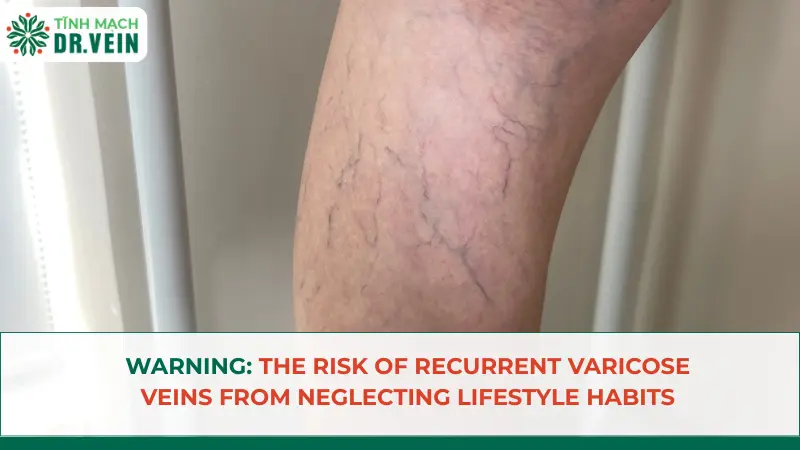
Venous insufficiency of the legs is a common condition, but not everyone experiences the same form of the disease. Even in the same person, the severity and cause of venous insufficiency in each leg can be completely different, necessitating a personalized diagnosis and treatment plan for each side.
The story of Mrs. D.T.N. (62 years old) is an example of a severe case of venous insufficiency lasting many years, with complex and uneven damage between the two legs.
Initial Condition: Living with Pain and Bulging Veins for Years
Mrs. N. came to Dr. Vein suffering from sharp pain, heaviness, and fatigue in both legs, especially in the left leg, where varicose vein clusters were clearly visible from the thigh down to the ankle. This condition had persisted for many years, frequently causing numbness and stinging pain, which affected her sleep and daily activities.
Clinically, the doctor noted raised varicose clusters on the left leg, along with clearly visible blue-purple veins on both legs—signs of advanced venous insufficiency.

Specialized Diagnosis: Two Legs, Two Types of Lesions
Dr. Le Kim Cao (M.D., MSc, Specialist Level II) performed a Doppler ultrasound to accurately identify the cause and extent of the damage. The results showed a distinct difference between the two legs:
Right Leg
Severe valvular insufficiency in both the great saphenous and small saphenous veins, with reflux lasting over 3 seconds. This is a typical form of venous insufficiency where blood flows backward from top to bottom, causing dilation of the entire superficial system at the back of the leg.
Left Leg
A perforator vein branch draining backward into the great saphenous vein trunk at the mid-thigh, also with a reflux time of 3 seconds. This is a complex form where an abnormal branch causes blood to flow in the wrong direction and stagnate heavily from the thigh down to the lower leg.
Final Diagnosis: Lower limb venous insufficiency, Grade C2.
Treatment Protocol: Personalized for Each Leg

Because the two legs had different types of lesions, the doctor developed a separate intervention protocol for each side to ensure thorough and safe treatment.
For the Right Leg:
- EVLA (Endovenous Laser Ablation): Using laser energy to fibrose (close off) the insufficient great and small saphenous vein trunks.
- Muller Phlebectomy: Removing large, visible varicose clusters under the skin.
For the Left Leg:
- Ligation of the Insufficient Branch: A minor surgical procedure to tie off the perforator branch draining backward, stopping the reflux flow.
- EVLA + Muller: Continuing to treat the main trunks and dilated clusters.
- UGFS (Ultrasound-Guided Foam Sclerotherapy): Supplemental injection for small branches and diffuse superficial veins.
The entire process was performed gently under light sedation (pre-anesthesia), helping the patient feel no pain or discomfort during the procedure.
Doctor’s Advice
After treatment, Mrs. N. was given detailed instructions to support recovery and prevent recurrence:
- Wear knee-high medical compression stockings (Class 1) when standing or sitting for long periods.
- Avoid postures like squatting, crossing legs, or standing continuously for a long time.
- Engage in gentle exercises like walking or cycling to improve blood circulation.
- Eat plenty of green vegetables and fruits, and maintain a reasonable weight.
- Follow up after 1 month to evaluate effectiveness.
Post-Treatment Monitoring – Significant Improvement
One month after treatment, Mrs. N. returned for a check-up. She reported that her legs felt lighter, and the stinging pain and heaviness she used to feel were gone. The protruding vein clusters that were once clearly visible on the inner and back thigh had collapsed, making walking and daily activities much more comfortable.
Upon re-examination, Doppler ultrasound showed that the previously insufficient veins were completely closed, with no remaining reflux. Dr. Cao noted this as a very positive sign, proving that the treatment process had achieved clear effectiveness.
After more than a month, the health of Mrs. N.’s legs has improved significantly in both sensation and aesthetics—proof that early diagnosis and correct treatment can restore venous circulation and help patients regain their quality of life.

Contact Information
- Address: No. 2, My Toan 2 Residential Area, Tan Phong, District 7, Ho Chi Minh City
- Hotline: 0932.19.28.82
- Website: drvein.vn/en
- Business Hours: Monday – Saturday, 8:00 AM – 5:00 PM